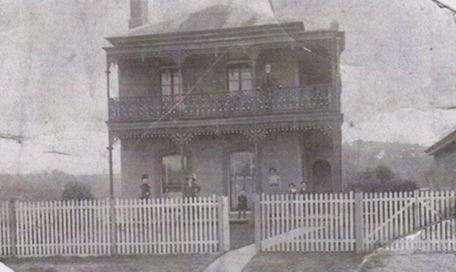
Auction: ‘Glenelm’ Coogee, Bream Street, view of ocean, close to tram and beach. Brick house on stone foundation, 9 rooms, in splendid order. A garden and coach house. 1911.
1914. Three little girls, dressed in their finest drop– waisted white frocks, dart across the backyard; their laughter rings out over the salty sea breeze. Spotless only moments ago, their dresses gather smudges of dirt as they play chasey in the garden. The children groan as they are called over for more photographs but obey, gathering in Grandma Thompson Capper’s backyard.
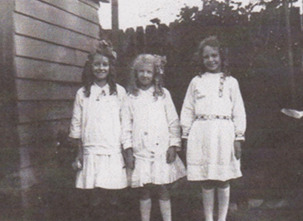
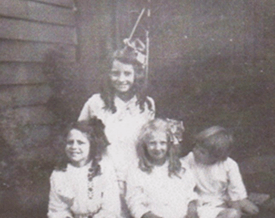
Lotus Thompson, May Capper, Beryl Thompson, Erroll Thompson
It is August 26, 1914; Lotus is turning ten years old. her party hat slightly askew. She remembers her old life – the wide fields and freedom of Charters Towers where she learnt to sink or swim in the Burdekin River, riding horses across the rugged landscape alongside her brother Eric and their cousins, Dicky, Beryl, and Joyce.
She dreams of other things now, how to dance, move, and command a stage like her idol, French performer, Gaby Deslys–– who she will dress as at the Coogee Mardi Gras. Her mother has already begun making her outfit.
A wicked grin spreads across Lotus’s face.
“Let’s play hide and seek,” she announces.
Even though Beryl is the eldest, she’s made to count. Lotus and Iris squeal and scatter, two younger cousins joining in, skirts flashing white as they vanish into the depths of the house.
Beryl yells, “Coming ready or not!” Inside the house, she pokes her nose into bedrooms and dark spaces without luck. Up there, she thinks, ascending the stairs. Through the window, she can see the sky meet the lavender seas of Coogee Bay, all the way out to Wedding Cake Island and beyond.
A rustling in the room gives them away and Beryl flings the wardrobe door open to ear piercing screams.
It is here, on the ruins of this grand old house, that The Flats were built, and where I first hear the story of Lotus, but the house itself had a history of its own. Glenelm had absorbed and suffered the untold anguish of a generation.
After the First World War, the house was converted from a private residence into a sanatorium—and makeshift hospital. Across the country, hospital beds were in short supply, overwhelmed by the sheer number of returning soldiers who were physically wounded and mentally shattered. These men, dismissed as suffering from “shell shock,” arrived at Glenelm with trembling hands, vacant eyes, and night terrors. The house became a repository of their anguish, its walls absorbing the long silences, the outbursts, the shuffling footsteps in the corridors at night.
By the early 1920s, Glenelm had been unofficially sectioned into four modest two bedroom flats. One was let to a drama teacher who turned it into a makeshift acting studio—voices rising and falling behind curtained windows, the scent of greasepaint lingering in the hallway.
One night in 1926, the beautiful Glenelm caught on fire, smouldering dramatically and burned to the ground. The fire came suddenly, leaving just the foundations and a charred wall, clinging to the earth like a memory. No one was inside when it happened—miraculously, there were no injuries—but Fanny Capper passed not long afterwards.
After his mother died, Bert was reminded of a notorious figure from his childhood in Charters Towers, a trickster known as Black Jack, who salted his mines with scraps of real gold, copper, even nickel—just enough to fool a buyer. Bert thought about doing the same – then he had a better idea.
He would salt his mine in Cootamundra, Christmas Gift, fake its value, and swap it for his sister, Laura’s, share of the land in Coogee. He reasoned it out: she wouldn’t know, and besides, he needed it more. His conscience stirred briefly, then fell silent. He went through with it and when Laura discovered what her brother had done, he was no longer her brother. It was said that she never spoke to him again.
Neither Bert nor his son Dick were builders, and it showed. Nevertheless, they rebuilt Glenelm from the ground up, and the result was a plain, uninspiring structure of four flats. No. 4 always leaked terribly. ‘One for each child,’ Bert said, ‘so they’ll always have a roof over their heads.’ But the house seemed to carry the memory of betrayal like a stain in the walls.
The curse began almost immediately. Marion Jesse, Bert’s wife, died less than a year after they moved in. A big lady, she shrank to next to nothing, and Bert followed six months later, it was said of a broken heart. All that remained were the children: Beryl, Joyce, Trevor—inheritors of a house rebuilt on scorched ground and secrets – and technically, Dick.
They gave my grandfather Flat 4, the worst one, with a badly leaking roof but relations between my grandmother and her siblings– in– law had soured.
Cootamundra had been wonderful in the beginning, even in cramped quarters but life had been cruel to my grandmother, taking her six month old baby boy, Robert, in a very bad winter. The family blamed her for taking the baby out in the weather, and Grandmother Marion had begged her to leave the baby at home.
He caught a cold that turned into pneumonia, and one freezing morning, she found him, too still in his cot. The next baby was a daughter who came a month too early and only lived for a few hours, so it was a wish come true when the next boy, Alan was born safely, followed by the arrival of my mother, Anne but they wouldn’t live in Unit 4. They rented the house next door for two years until they were forced to move constantly, and even further away, through the housing crisis of the 1940s.

 Lotus Thompson: Silent Film Star
Leave a reply to Melissa Anderson Cancel reply