It was not quite equal billing – an article appeared about the Wampas Ball, and directly underneath that another article about the actress who ruined her legs with acid in order to have a chance at ‘real acting’. Surely, Lotus is having a subtle dig while she makes the most of her newfound notoriety. This whole stunt was planned to coincide with the Wampas Ball and to gain maximum competitive exposure.
February 4, 1925, an article is published. ‘Actress Happy Over Sacrifice’. It says “In Australia, she is a film and stage actress, who would soon be working in a serious role.”
“I am overcome with joy…at last, I am to have my chance at real acting.’
The article refers to international star, Rudolph Valentino, who appeared to be impressed by her sacrifice; he was also attending the ball.
While most articles reporting on the incident are much less prone to hyperbole, and are nowhere near as dramatic as the story referring to gaping holes in her flesh, most versions detail nitric acid running down her too beautiful legs in order to land a dramatic role.
Then there’s a third version: it was all completely fabricated, a daring stunt that even fooled Hollywood.
Here’s the other angle, an obscure teenage actress from Australia arrived in Hollywood only to scorn the almight directors of Hollywood who wouldn’t give her dramatic roles because of her too beautiful legs.
A silent woman, not a star, she is given an opportunity to express genuine feelings of injustice and it was an extraordinary performance.
‘Directors never give me a chance at a serious part.’
A body double with lovely legs, she was paid decently – but that did not an actress make.
‘Some girls might have been satisfied with being admired just on that account, but I wasn’t…I want to be a real actress. That is the one great dream of my life. That’s what I have been aspiring to since I came to America from Australia a year ago.’
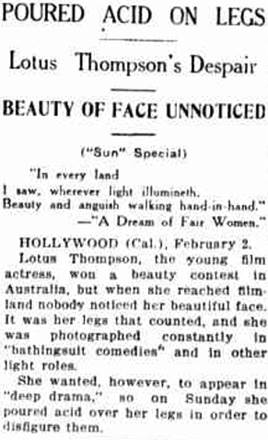
The date of the acid stunt coincided with the Wampas Ball and marked almost a year since her arrival. With a career in Australia that had already spanned seven years, including dramatic roles on the stage and in film work, she held an expectation that, in America, she would play dramatic roles, but they were not forthcoming. This would not do for the headstrong thespian from the Antipodes.
‘I wanted to disfigure my legs so that nobody would ever want to look at them again.’
This was a time of profound transformation and paradox that Lotus embodied, suddenly wary about displaying her legs, though she displayed her limbs on stage and in many Australian films.
For Lotus, the irony was high: she was an actress, not a novelty act —she was a performer with ambitions beyond being admired for her figure, but to get directors to see any of that, she had to be the spectacle.
Suddenly, people were listening, she could finally describe the daily frustrations of a pinch– hitter:
“My life– long ambition grew to be Hollywood for I was told that I couldn’t fail to be appreciated. So I packed up and, with mother, came here. I was employed right away and have been kept busy for a year, mainly in comedies. But that wasn’t what I wanted. It got to be legs, legs, legs.
At first, I didn’t mind it. The work was easy – even the brightest girl can’t exert much acting through her legs – and the salary was adequate. But the horror of always feeling that no one was looking at my face, which isn’t a bad face at all, and the dread of the repetition of the demands of my time and patience were really too, too much!
Then, sharing a discussion she had with a director:
“Suppose something happened to my limbs? Would you then give the whole me an opportunity to show what I can do in the way of genuine acting?”
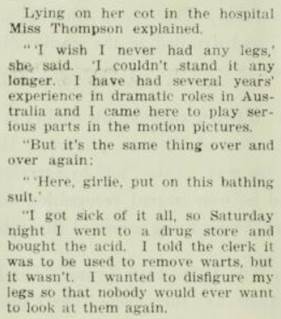
‘Scars give me freedom from a dreadful slavery.’
The scars were faint, if at all, but there was no such thing as freedom for women in Hollywood. The Tallulah Bankheads and the Bette Davis’s of the world might’ve gotten away with it, but most actresses did not. Hollywood offered female stars the power of celebrity but placed them under strict studio control, inserting morality clauses and weight clauses, demanding they maintain the idealised image of the modern woman: sexy, but not scandalous; thin but not skeletal, confident, independent, but not threatening. Masculinity, too, was shifting but neither men nor women had a guide for this new world. The old rules were crumbling, but no clear path had been laid in their place.
After a few weeks had passed, articles appeared that raised the possibility of an exaggeration, that despite doctors confirming disfigurement for life, Lotus, described as intense, imaginative, and ambitious, would heal unscathed. The articles conformed to the same pattern of events – from the bathroom to the hospital, the pharmacist, police officers, doctors, and her mother, lent the story credibility. Only one or two articles denied the story outright.
The days and weeks ahead, from the hospital back to her home stand as a testament to one of the longest and drawn out auditions of all time, and the irony of it all is that she had to embark upon a stunt in order to be taken seriously.
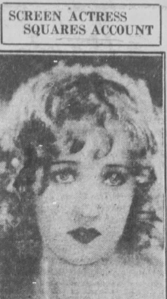
 Lotus Thompson: Silent Film Star
Leave a comment