At first, the aspiring Australian actress was pragmatic. The studios wanted her—if only for her figure. Still, it was a foothold. A way in. If she could just be in the right place at the right time, she might meet the right person, catch a director’s eye, ask for a part among the dozens of films shooting daily.
It seemed possible.
What Lotus hadn’t accounted for was the rigidity of the Hollywood machine. Never, in her wildest imagining, had she pictured herself standing in a studio all day while her limbs were photographed—over and over, reduced to fragments.
An article in the San Francisco Examiner in April 1924 set the tone:
“Winner of half a dozen beauty contests, Miss Thompson, just eighteen years old, proves that the Australian Ziegfelds used rare judgment in their prize selection.”
It read like fact. It wasn’t true but American papers could say what they liked about a newcomer from another land. Australian newspapers could also say what they liked about an actress who was very far away. Who would check?
Newspapers and studios worked in tandem, manufacturing allure—beauty titles, origin stories, carefully shaped personas. Truth was optional. Visibility was everything. Across April and May, versions of the same story appeared in seventy newspapers across the United States, each one amplifying the last.
The golden-haired Australian had arrived.
Or rather, the idea of her had.
Photographs circulated. Columns were reprinted. Her image travelled further than she could. By mid-June, she was no longer new. The story had lost its value.
One by one, the papers dropped her. From Mississippi to Virginia, Michigan to Montana, Kentucky to Oklahoma, California to Indiana, Ohio to New York—the coverage thinned, then vanished. On 20 June 1924, the arrival story died its slow death.
And with it, the illusion of momentum.
In July, Australian papers reported that Lotus had reconnected with her friend Enid Bennett, whom she had appeared with at the Sydney Movie Ball the year before. Bennett had married Fred Niblo—a powerful figure, older, established, embedded in the industry Lotus was still trying to enter.
Niblo had made films in Australia before moving to Hollywood, working with Paramount and later MGM. His most famous production, Ben-Hur: A Tale of the Christ (1925), would become one of the most expensive films of its time, backed by Louis B. Mayer and Irving Thalberg.
This was proximity to power. The kind that was supposed to change everything.
Later retellings—Wikipedia among them—would flatten this moment into myth: that Lotus had been “picked out of a crowd” by a Paramount director. The line is repeated so often it begins to sound like truth.
It isn’t.
What we do know is smaller, and more telling. In late July 1924, Bennett told American newspapers that her husband had given Lotus a screen test the previous week. She described her as having “just arrived”—though Lotus had been in America for four months.
Even here, the story was being reshaped.
The tests, Bennett said, were promising – a role will follow.
But publicity was a patchwork of wishful thinking stitched together with invention.
In August came the change, after six months of hustling:
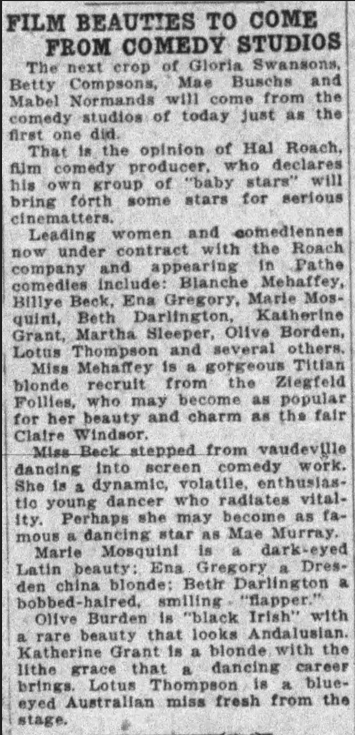
When Lotus finally appeared on screen in October, it was a fleeting role in a Hal Roach Studios short—so brief it was almost invisible.
Blink, and you’d miss it.
 Lotus Thompson: Silent Film Star
Leave a comment