Know thy Child 1921
‘Where are our cinema stars of the past – the women who thrilled our hearts and filled our picture theatres, the bush– girl heroines, the fearless virgins and wicked city vamps? ‘Call me a star, call me a sensation, but … Don’t Call Me Girlie’ (1985)
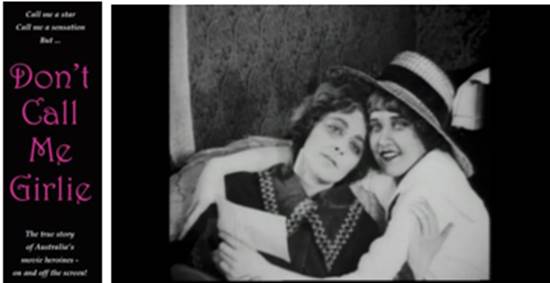
With Vera James, Know Thy Child
What did happen to our female film pioneers?
My grandmother cut out a newspaper clipping about a documentary called Don’t Call Me Girlie in 1985. Nanna Thompson remembered the film, Know Thy Child, but wouldn’t say what it was about, as if it was slightly shameful.
I was sixteen, the same age that Lotus was when she started out in film. We all sat in a dimly lit room, rows of plain black chairs facing a makeshift screen. My friend and I eagerly shuffled into our seats, in a room full of much older women, as the tribute to Australia’s pioneering, discarded women of cinema begins.
There are interviews and photographs and (finally) they briefly talk about Lotus, from the film Know Thy Child, who went to Hollywood.
A floating voice on the screen (not hers) sighs:
‘It’s the same thing, over and over again. Come here, girlie. Try on that bathing suit.’
And not much more is said, but for a brief remark about pouring acid on her legs. Lotus comes across as tragic and forgotten, even for the forgotten film pioneers. I appreciate a mystery but I still had so many questions. What happened to her?
Know Thy Child 1921
The papers wrote:
‘It is not often that a girl, entirely unused to the vagaries of the movie camera, yet, Lotus Thompson, the little Sydney girl who is to be promoted to stardom by W Franklyn Barrett, has acquitted herself remarkably well in all trials held so far before the merciless all– seeing eye. She is not yet seventeen and possesses all the requisites of the successful artiste.’
It has been written, many times, that a beauty contest win at Bondi Beach, led to a film role. Sadly, there is no hard evidence, nothing that can be accurately sourced or referenced. There was a contest for surf sirens, the judge was sculptor, Nelson Illingsworth, and he awarded prizes but the name Lotus Thompson was not one of them. Sometimes we see what we want to see.
The film’s subject matter proved too much for its original leading lady, actress Wendy Osborne, who withdrew from the production, informing the Film Commission that the storyline “offended her moral sense.” Osborne was twenty-two years old, and when the role was recast, it went to sixteen year old Lotus.
The film was as shocking as it was controversial, a one-of-a-kind oedipal drama, peppered with workplace sexual harrassment – a cautionary tale of moral condemnation with terrible consequences.
The character that Lotus plays moves from the bush to the city for greater opportunities, only to be pursued relentlessly by her insatiable employer. As his unwanted advances escalate, the horrifying truth is unveiled; he is her biological father, who had vanished years earlier after a very brief affair with her mother.
Director and cinematographer, Walter Franklyn Barrett was a pioneer of early Australian cinema. With a career spanning over two decades, Barrett directed at least 27 films, including Pommy Arrives in Australia (1913), The Pioneers (1916), Australia’s Peril (1917), Breaking of the Drought (1920), and A Girl of the Bush (1921).
Know Thy Child divided critics. There were those who hailed it as groundbreaking, ‘a picture of which all good Australians may well be proud,’ promising audiences the thrill of seeing familiar landscapes on the screen.
However, moralists and censors were less than impressed, and condemned the work outright. This film, they said, was exactly the kind of production the Commonwealth censors were working to keep out of the country.
Despite its scandalous nature, Know Thy Child arrived at a pivotal moment in Australian cinema. Though working with modest budgets, local filmmakers demonstrated remarkable ingenuity and technical skill, producing films that captured the growing sense of national pride. Reviews, advertisements, and endorsements fuelled this patriotic fervour, with the film hailed as ‘the pinnacle of Australian film– producing experience, surpassing many imported super– productions.’
Barrett lived at 22 Frenchmans Road, Randwick, a house still standing today, only a few streets away from the Thompson residence. Barrett House is recognised for its place in Australian film history, where scripts were written, films were edited, and cinema was made.
We may never see Know Thy Child for ourselves as it is a lost film, but selected images are held at the National Film and Sound Archives, Canberra.
 Lotus Thompson: Silent Film Star
Leave a comment